
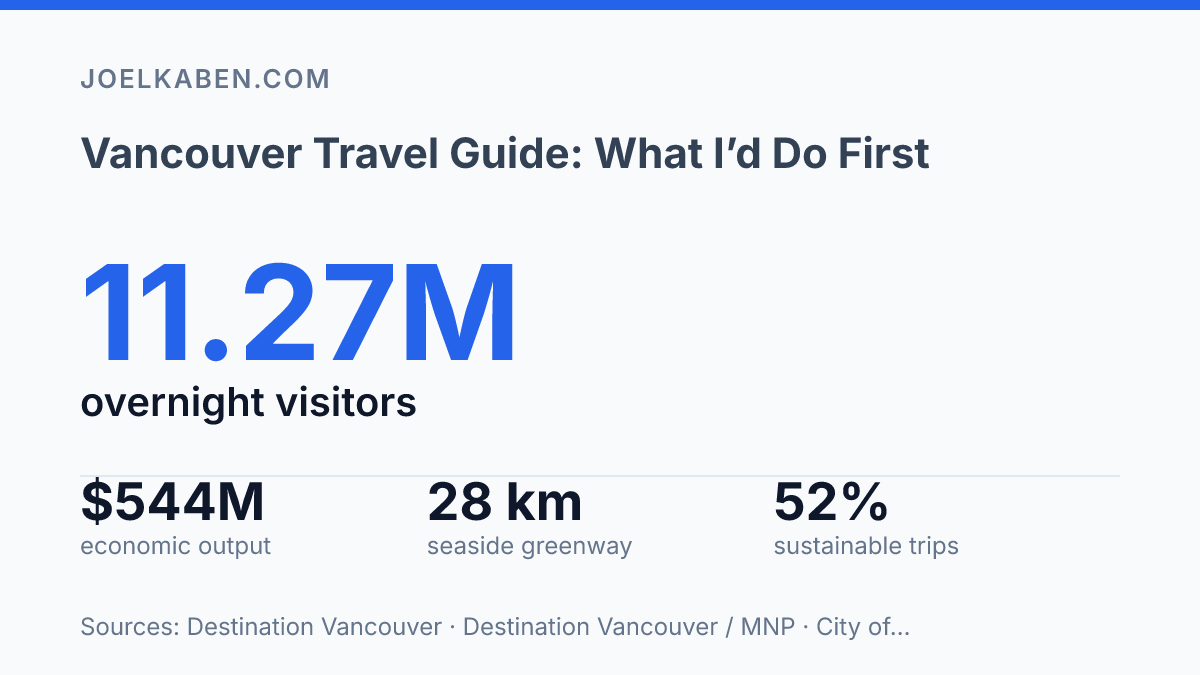
Vancouver pulled in 11,271,967 overnight visitors in 2024. The smartest first day here can still cost less than a taxi from the airport.
That tension is the city in miniature: big demand, limited hotel rooms. A layout that rewards anyone who refuses to overplan.
I learned fast that the easiest wins aren’t the famous stops first. They’re the neighborhoods where you can walk from coffee to seawall to SkyTrain without turning the day into logistics.
More than half of daily trips here now happen by foot, bike, rolling, or transit, and visitor figures from Destination Vancouver explain why August can feel tight. In my honest opinion, I’d spend less time chasing a perfect itinerary and more time choosing the right base, the right first neighborhood. The few experiences that deserve real money.
Why Vancouver feels easy to love fast
I can land, drop my bag, and be looking at snow-cut mountains from the waterfront before my phone has fully adjusted to Pacific time. That’s the trick this city pulls on me every time: it feels dramatic without making the first day hard.
The airport train, the compact downtown core. The water’s edge all make a short trip feel bigger than it is.
The 2010 Winter Olympics pushed the city onto a broader travel map. The legacy I notice isn’t just sports venues or old signage.
It’s the confidence. The place knows how to receive visitors, move crowds, and package itself cleanly without feeling like a theme park.
That polish has numbers behind it. The city logged 11,271,967 overnight visitors in 2024, up 3% from 2023, and August alone brought 1,500,565, according to Destination Vancouver, 2024, Market Origin of Overnight Visitors to Greater Vancouver. You feel that in summer prices and busy waterfront paths, so I wouldn’t treat spontaneity as a full plan here.
Stanley Park is the best example of why the city is so easy to like fast. It sits right beside downtown, so I don’t have to choose between “city day” and “nature day” on a short visit. I can walk from glass towers to forested paths in minutes, then be back near dinner without a car.
The Seawall works better for a first impression than a famous city-center stroll like New York’s High Line, at least for my kind of trip. The High Line is clever and urban.
The Seawall gives me distance, water, skyline, mountains. A simple route I don’t need to decode. In my view, that’s the smartest first-day move, not because it’s hidden, but because it shows the city’s layout in one easy sweep.
Still, the calm look can fool you. The best parts are spread out just enough that first-timers need a loose plan, especially if they want neighborhoods, beaches, food, and views in the same day. I’d keep the first day simple: pick one strong route, let the city impress you, and don’t pretend you can casually cover everything.
My first stop: neighborhoods that show the real city
The steam clock is corny, crowded, and still one of the smartest first stops I’d make. Gastown gives you an easy visual anchor: brick streets, old warehouses, souvenir shops. That famous clock puffing away on the corner.
It was built in 1977, so it’s not some ancient relic, but that’s part of the fun. It performs every 15 minutes, and everyone pretends they weren’t waiting for it.
I wouldn’t spend half a day there, though. This is the tradeoff with the most famous areas: they’re simple to reach, easy to photograph, and not always the places that feel most like Vancouver. I’d go, take the photo, wander a few blocks, then move on before the tour-bus mood takes over.
Granville Island is the next place I’d choose, especially for the public market. I like it because it feels built for wandering without needing a plan.
You can grab fruit, pastries, coffee, or picnic supplies, but I wouldn’t turn it into a checklist of food stalls. The better move is to slow down and watch the mix: locals shopping, visitors staring at the harbor, buskers holding a crowd, and tiny boats sliding in and out.
The city’s real personality shows up more clearly once you leave the polished downtown towers. Commercial Drive has that looser, lived-in feel I always look for on a first visit.
Kitsilano works too, especially if you want beach energy without feeling trapped in the downtown grid. Neither area hits you with one famous landmark, but that’s the point.
According to the 2024 Transportation Survey, the CBD–West End area had a 71% share of trips by walking, biking/rolling, or transit. That explains why the central neighborhoods feel so easy at first. In my honest opinion, the mistake is assuming convenience equals character. I’d use the core as a launch point, then give my real time to the neighborhoods where people actually linger.
Getting around without wasting half the day
The fastest airport move here is usually the train, not a car with a meter running in traffic. TransLink runs the main public transit network, and I’d use it before pricing out a private transfer. The Canada Line connects downtown with Vancouver International Airport in under 30 minutes, according to YVR, which is hard to beat after a flight.
There is one annoying catch. As of July 1, 2026, TransLink lists a $6.50 YVR Airport AddFare on trips leaving Sea Island stations.
The airport ride isn’t priced like a regular hop across town. Still, for one or two people, it usually beats a taxi once traffic and tip enter the math.
I treat the train as the spine of the trip, then fill in the gaps with walking, buses. The occasional ride share.
The city’s 2024 Transportation Snapshot says about 52% of daily trips happen by walking, biking or rolling, or transit. That matches how I’d move here: not car-free as a badge of honor, just car-free because it’s often simpler.
Walking wins when the map says 15 to 25 minutes and you’re already in the same part of town. By the time a ride share finds you, loops around one-way streets, and drops you a block from where you meant to be, you could have arrived. In my humble opinion, I’d rather spend that money on coffee, snacks, or one better meal.
But don’t let the compact map trick you. Rain changes the mood fast, hills punish lazy routing.
A short-looking cross-town plan can eat half an afternoon. If I’m crossing between neighborhoods, carrying bags, or trying to make a reservation, I’ll use transit first and save taxis for late nights or bad weather.
My simple rule is this: walk for atmosphere, take SkyTrain or bus for distance, and use ride share only when it solves a real problem. That keeps the day moving without turning transportation into its own expense category.
Where I’d spend money, and where I wouldn’t
I’d rather pay for one great view than three mediocre admissions that turn the day into receipt collecting. Some of the most obvious tourist buys are the easiest to skip. A few paid stops earn their place if they give you a story, a view, or access you can’t fake on a walk.
Accommodation is where I’d make the first serious call. The city’s tourism board listed just 13,007 hotel and motel rooms in the city in 2024, with most of them downtown. The central rooms can disappear fast when events hit.
That doesn’t mean downtown is a mistake. It means you should know what you’re buying: shorter days, easier evenings, and less backtracking.
Burnaby and Richmond can make more sense if the room is near a SkyTrain station. You may save enough to eat better or book one paid experience without feeling squeezed. The tradeoff is simple: you’ll spend more time in motion, and late-night returns feel less effortless than stepping out of a downtown restaurant and walking back to your room.
The paid attraction I’d think hardest about is Capilano Suspension Bridge. It’s memorable, dramatic, and polished for visitors, but it’s not the only way to feel the trees and water around here.
If you care about that engineered-over-a-canyon thrill, pay for it. If you mainly want forest air, I’d put the money toward food and choose a simpler outdoor plan.
Food is where I wouldn’t get too clever. Seafood belongs to the city’s identity, and I’d budget for at least one proper plate of salmon, oysters, sablefish, or spot prawns when they’re in season.
Don’t chase the fanciest room by default, though. A casual counter, fish-and-chips spot, or neighborhood restaurant can give you the same coastal signal without the performance.
Coffee deserves a real line in the budget too. Not a huge one.
Just enough to skip the bland chain habit and sit somewhere local for twenty minutes between walks. In my view, the smartest spending here is rarely the biggest splurge. It’s the purchase that slows the day down and makes the city feel less like a checklist.
My rule is blunt: pay for location when time is short, pay for one view if it truly matters to you, and don’t let souvenirs beat meals. You’ll remember the harbor light and the seafood far longer than another branded hoodie.
The choice that decides whether your first day feels easy
If I were planning my next Vancouver trip, I’d choose my hotel by the transit map first and the postcard view second. The city had only 13,007 hotel and motel rooms inside city limits in 2024, so waiting can turn a simple stay into a pricey compromise.
The practical move is plain: book early, or stay close to SkyTrain and let the city do the work. From YVR, the Canada Line already beats most airport transfers for ease. After July 1, 2026, TransLink’s airport AddFare makes that ride a little less cheap, but still hard to beat.
In my humble opinion, the best first trip here isn’t the one with the longest checklist. It’s the one where you don’t spend your best hours getting unstuck.
Frequently Asked Questions
Q: What should I do first when I arrive in Vancouver?
A: I’d start with a walk through downtown and the seawall. It gives you the fastest read on the city, and you’ll feel the mix of water, glass, and mountains right away. In my view, that first walk matters more than rushing to a list of sights.
Q: How many days do you need for a first trip to Vancouver?
A: Three full days is the sweet spot for a first visit. You can cover the city core, get out to the parks, and still leave room for a slow meal or two. Less than that feels rushed… and Vancouver punishes rushed trips.
Q: Is Vancouver easy to explore without a car?
A: Yes, and I’d actually recommend skipping the car unless you plan side trips. Transit, walking, and rideshares cover the main areas well, but parking gets annoying fast. You’ll save time, money. A lot of frustration.
Q: What area should I stay in for a first visit to Vancouver?
A: I’d look at downtown, Coal Harbour, or near Yaletown. Those areas make it easy to get around and keep you close to the water, restaurants, and major sights. If you stay far out, you’ll spend more time commuting than enjoying the city.
Q: When is the best time to visit Vancouver?
A: Late spring through early fall is the easiest stretch for a first trip. You get longer days and a better shot at clear views. The tradeoff is bigger crowds and higher prices. If you want a quieter feel, shoulder season is a smart move.