
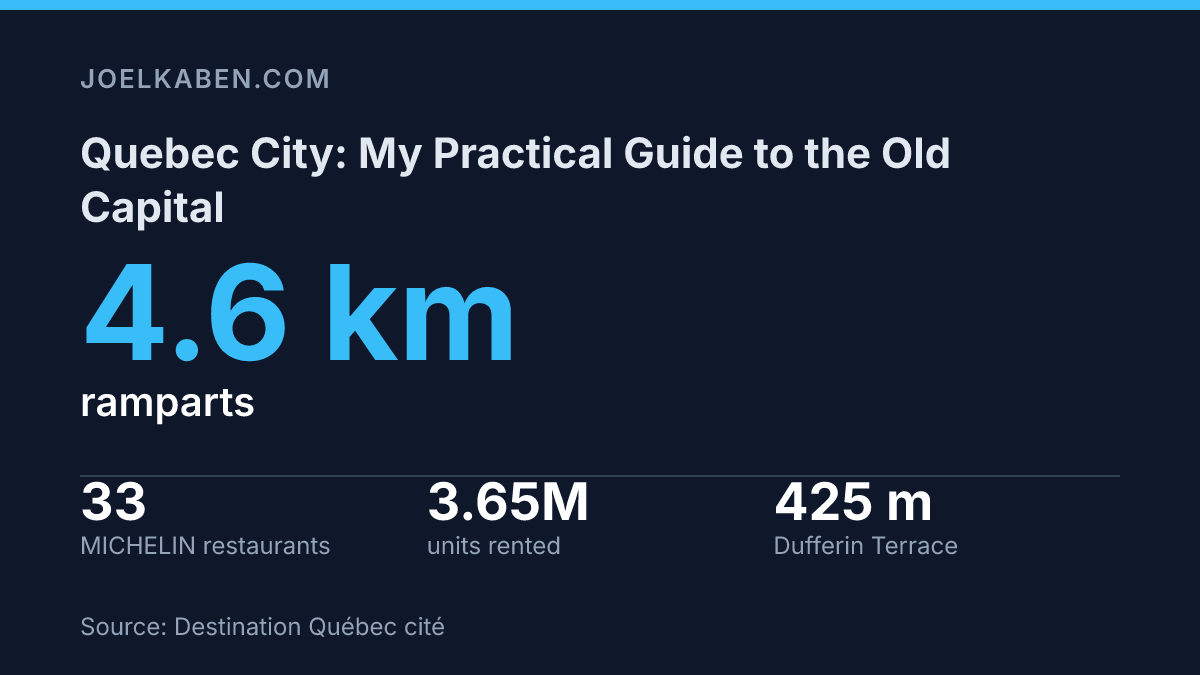
Quebec City still keeps 4.6 km of ramparts in place. The old capital doesn’t just look historic. It forces you to move through history on foot.
I felt that most clearly in Old Québec, where gates, steep streets, stone walls, and sudden river views make a short walk feel bigger than the map suggests. The walls took shape between 1608 and 1871. The practical question is much more current: how do you see it well without wasting half your day on climbs, queues, or the wrong shoes?
That’s the angle I care about here. I’ll show you how I’d pace the Upper Town and Lower Town, where I’d pause for food, and what I’d sort out before arriving. Summer brings crowds and higher room rates.
Winter brings deep snow, real cold. A city that feels sharper for it. In my honest opinion, that contrast is exactly why planning matters here.
Why I’d Start in Old Quebec
Inside the walls, four centuries sit close enough that I can cross them before my coffee gets cold. That’s why I’d start here on a first visit to Quebec City, not at the biggest viewpoint or the most photographed hotel. Old Quebec gives you the city’s shape right away: gates, steep lanes, stone buildings, church bells, delivery trucks, school groups, and locals trying to get through it all.
The walls are the reason this area feels different from almost anywhere else in North America. According to Destination Québec cité, the old defensive system still has 4 gates, 3 Martello towers, the Citadelle, and ramparts built between 1608 and 1871, including Fortifications spanning about 4.6 km.
I don’t treat that as trivia. I treat it as the best walking route in town.
Recognition in 2008 put another official stamp on Old Quebec’s protected status as a UNESCO World Heritage Site. The place doesn’t feel preserved in glass.
That’s the trick. You can stand near a postcard view, then turn down a side street and run into someone carrying groceries, a café owner clearing snow, or a busker playing to five people instead of fifty.
The history feels heaviest when you remember the Battle of the Plains of Abraham. I wouldn’t start with a full history lesson here, though. I’d let the old streets do the first round of explaining, then let the battlefield and museums add weight later.
Old Quebec looks compact and simple on a map. That can fool you.
The best moments aren’t always the obvious stops like Château Frontenac or Dufferin Terrace, even though I’d still walk past both. In my view, the real charm comes when the grand old capital bumps into daily life. You catch both in the same narrow street.
How I’d Spend a Day Between Lower Town and Upper Town
I’d do the steep part once on purpose, then let the shortcut rescue me later when my calves start negotiating. That rhythm makes the day feel easy without flattening the city into a checklist.
I’d start low, around Place Royale, then drift into Petit-Champlain before the lanes fill up. This is where I slow down rather than “cover ground.”
The shops are close together, the corners are tight. The whole area rewards looking sideways as much as looking ahead.
By midmorning, I’d aim for Rue du Petit-Champlain, especially if photos matter to you. It earns the attention.
It can also feel staged if you hit it at the busiest hour. Go early, take your pictures, then put the camera away for a few minutes. In my honest opinion, that’s when the street feels less like a backdrop and more like a real place.
For the climb, I’d choose the hill at least once. The Funiculaire du Vieux-Québec saves your legs, but walking up gives you the better read on the city’s scale and character… and that tradeoff matters more than most guides admit. You feel the grade.
You notice how quickly the views change. You understand why Lower Town and Upper Town don’t blur together.
After that climb, I’d keep Upper Town simple. I’d wander the smaller streets, pause when something pulls me in, and avoid packing the afternoon with too many stops. This is the part of the day where less planning works better.
Later, I’d use the funicular going back down if I were tired or short on time. There’s no prize for doing every slope the hard way. The best day, for me, is one that mixes effort with ease: walk when the route tells you something, ride when it only repeats the same lesson.
Where the food and winter feel different
A January night around -18°C changes what food you crave, and that’s exactly why the city feels more honest in winter. Destination Québec cité lists winter averages of 305 cm of annual snowfall, with January temperatures around -8°C by day and -18°C at night.
That kind of cold doesn’t politely decorate a trip. It takes over the rhythm of it.
The quickest way I’d read the local food mood isn’t through a long tasting menu. It’s through a paper tray at a Casse-croûte, the Quebec snack-bar tradition where poutine, fries, burgers, and quick comfort food make complete sense. It’s not refined, but that’s the point. In my humble opinion, this is where the city tastes most like itself.
That doesn’t mean the food scene is casual only. In the 2026 MICHELIN Guide Québec selection, the city had 33 honoured restaurants, according to Destination Québec cité. I like that contrast: you can eat something carefully plated one night, then want squeaky cheese curds and gravy the next afternoon.
Even when I’m not staying at Fairmont Le Château Frontenac, I still use it as a visual anchor. In summer, it can feel almost too polished, with everyone orbiting the same grand view. In winter, though, the building looks heavier and more dramatic, like it belongs to the snow rather than the postcards.
The cold is a barrier, but it’s also a filter. Some people won’t enjoy stepping over slush, tightening scarves, and ducking into warm cafés every hour.
I get that. But if you can handle it, the reward is a city that feels less staged and more local.
The Winter Carnival shifts the mood again because it turns cold weather into the main event, not an inconvenience to survive. Streets feel less like a backdrop and more like part of the celebration.
That’s the winter trick here: the season doesn’t soften the city. It sharpens it.
What I’d plan before you go
The mistake I see most first-timers make is booking one night and then spending half the visit recovering from transit. I’d give myself 2 to 3 days for the main sights, meals, and one slower morning. Less can work, but only if your hotel sits inside or right beside the old centre.
Flying in is simple enough through Québec City Jean Lesage International Airport, which sits west of the historic centre. I’d still check transfer times before choosing a late arrival. A cheap fare loses its charm fast when you land tired, wait for a ride, and reach your room after dinner service.
Hotels deserve more planning than people expect. Destination Québec cité reported that accommodation units rented in the region rose from 3.49 million to 3.65 million in its latest annual report.
This isn’t a place where I’d assume last-minute deals will appear. The same report put the average daily hotel rate at CA$223, up from CA$212, which is a real difference if you’re staying three nights.
Summer needs the earliest booking. June through September made up 40.7% of all rented tourist accommodation units in the region, according to Destination Québec cité, so I’d reserve rooms and key restaurants before locking in every little activity. If you prefer quieter streets and lower pressure, I’d look at shoulder-season dates instead.
A short stay works if you stay central. The trip gets better when you leave one gap in the schedule.
For me, that gap would go to Montmorency Falls. It changes the whole rhythm of the visit: stone streets one day, loud water and open space the next.
I’d also plan around weather with more honesty than optimism. In colder months, I’d pack boots with grip, a proper coat, and gloves I can actually use with my phone. In my view, the prettiest version of the city is also the one that punishes lazy packing.
For getting around, I wouldn’t rent a car unless I had plans beyond the city and the nearby falls. The local RTC transit network recorded more than 31.5 million trips in 2024, according to Réseau de transport de la Capitale, and taxis or rideshares fill the gaps. Keep the car decision tied to your itinerary, not habit.
What I’d lock in before the old capital makes the choices for you
The smartest move is boring: book the rooms and dinners before the romance gets involved. In 2025, summer months made up 40.7% of all rented tourist accommodation in the region. That pressure changes how a trip feels.
I’d also treat transport as part of the plan, not an afterthought. The RTC carried more than 31.5 million trips in 2024, so you’re not relying on a token bus system.
But winter still punishes loose plans. Snow, stairs, and short daylight can turn “we’ll figure it out” into a cold mistake.
In my humble opinion, the best visit here isn’t the packed one. It’s the one with enough space to notice the city between stops.
Frequently Asked Questions
Q: How many days do I need in Quebec City?
A: I’d give it 2 to 3 days. That’s enough time to see Old Quebec, wander the hilltop streets, and still slow down for a good meal. One day feels rushed, and that’s the trap.
Q: Is Old Quebec walkable without a car?
A: Yes, and that’s how I’d do it. Most of the main sights sit close together. The hills can wear you out fast. Wear decent shoes, or you’ll feel every cobblestone by lunch.
Q: When is the best time to visit Quebec City?
A: I like late spring and early fall best. The weather is easier, the streets feel less packed. You can enjoy the city without freezing through every stop. Winter has its own charm. It asks more from you.
Q: What should I not miss on a first trip to Quebec City?
A: I’d make time for the old fortifications, the Lower Town. A long walk around the Château Frontenac area. Those spots give you the clearest feel for the city’s character. In my view, that mix of polished landmarks and rougher side streets is what makes the place stick with me.
Q: Can you visit Quebec City on a budget?
A: Yes. You need a plan. Walking the old streets costs nothing, and plenty of the best views are free, but food and hotels can climb fast in peak season. I save money by booking early and picking one or two paid experiences instead of trying to do everything.