
Man City whistleblower Rui Pinto facing ‘dire consequences’ – lawyers centres on a protection order due to expire on 10 October 2026, after six years in a special security programme. The decision matters because it is not limited to police escorts or routine security paperwork: Portugal’s witness-protection framework can cover confidential housing, identity details in official documents, transport and subsistence support. Pinto’s lawyers argue that removing those safeguards without proper procedure raises due-process concerns, while officials point to a PSP reassessment that placed him at “low” risk after commission meetings in June and July 2026.
The dispute sits beside the wider Football Leaks fallout, including Manchester City’s 42-day Premier League hearing, a 7,000-page record and allegations covering nine seasons. It also follows a reported assault on Pinto in Lisbon, making the risk assessment more than an administrative question.
Why the protection decision matters
The immediate stakes are not abstract: the decision could remove protected accommodation before any substitute security arrangement is confirmed. According to ECO/Lusa, Rui Pinto was notified on Wednesday that the special security programme he has had since August 2020 is set to end on October 10, raising the prospect that he could lose confidential housing and face uncertainty over continued police protection.
The warning came in a joint statement from his Portuguese lawyers, Francisco Teixeira da Mota and Luisa Teixeira da Mota, and his French representatives, William Bourdon and Vincent Brengarth. Their central argument was practical as much as legal: once the programme ends, the secure residence assigned to Pinto would no longer be guaranteed, and he may have to find a new home urgently. That is why they described the move as a decision with dire consequences rather than a routine administrative change.
What makes the timing significant is the gap between procedure and effect. Even if the authorities consider the protection no longer justified, the lawyers say the change may take force within days, before any replacement housing or security framework is in place. For a figure whose public profile is tied to active legal proceedings and sensitive disclosures, the loss of confidential accommodation is not merely a change of address; it alters the conditions under which personal security is managed.
What his lawyers say about due process
The sharpest legal objection in Pinto’s lawyers’ statement is not that protection can never change, but that he was allegedly given no prior hearing before a decision affecting his safety. They said that a prior hearing is required by law, framing the dispute as a procedural failure rather than only a warning about personal risk. That distinction matters because the statement challenges the way the decision was reached, not just the practical result it may produce.
Portuguese witness-protection legislation gives context to that claim without requiring a broad reading of the system. Law 93/99, as consolidated after later amendments and published in the Diário da República, allows special security measures to include steps such as altered identity details in official documents, relocation, transport support and a subsistence allowance. The same legal framework generally requires the beneficiary to be heard before suppression of protection for alleged breaches of programme rules, which is the procedural safeguard Pinto’s lawyers say was not respected.
According to ECO/Lusa, the order by the Special Security Programmes Commission followed meetings on 8 June 2026 and 9 July 2026, and cited alleged lack of commitment to the programme as well as a PSP reassessment placing Pinto at a “low” risk level. That reported reasoning may explain why authorities considered a change, but the lawyers’ point is narrower: even if officials believe there are grounds to alter the arrangements, they argue that the person affected should first have the hearing the law provides.
The statement also said Pinto could be left with no guarantee that police protection would continue once the programme ends as planned. That makes the due-process complaint immediate rather than abstract. In the lawyers’ framing, the absence of a prior hearing is not a technical objection detached from reality; it is the step they say should have occurred before a decision capable of changing his day-to-day security was allowed to take effect.
Past threats and the Lisbon assault
The legal team’s strongest concrete safety example is not a prediction but an alleged assault in Lisbon last April. In their statement, the lawyers said the threats against Pinto are “not merely theoretical,” pointing to that incident as evidence that the risk assessment cannot be treated as an abstract exercise. The claim matters because it shifts the argument from general anxiety around a high-profile source to a specific episode of physical harm, even though the lawyers did not set out further details about who was responsible or what motive, if any, was established.
A Bola reported on 29 May 2026 that the assault took place in the Campo Pequeno area at the end of April during an outing from Pinto’s police-protected residence. The same report said the PSP was informed, but that no formal complaint was filed. Those details do not settle the broader security question, but they give context to why the lawyers frame the issue as immediate rather than speculative.
Their risk argument is also tied to the nature of Pinto’s disclosures. The lawyers said his revelations implicated powerful figures with vast resources, a formulation that stops short of identifying a source of threats but explains why they believe ordinary assumptions about personal safety may not apply. The assault therefore strengthens their case for continued protection, yet the statement does not show whether the authorities will extend or revise protective measures on that basis.
Open legal cases and the wider fallout
The lawyers’ key point is that Pinto remains exposed while the legal afterlife of his disclosures is still unfinished. In their statement, they said “numerous resulting legal proceedings are still ongoing,” a claim that matters because the security decision is being made while related cases continue to attract legal, institutional and media attention. That means the fallout from his disclosures extends beyond his personal protection status and remains tied to active proceedings rather than settled history.
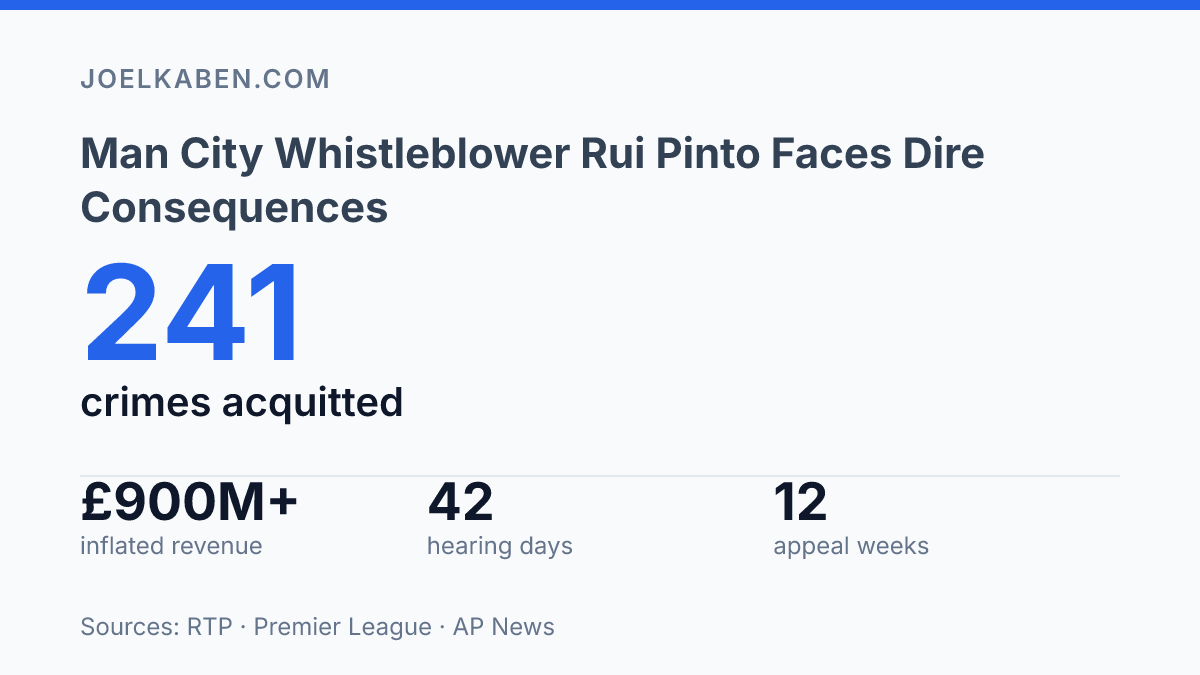
The link to Manchester City is one part of that wider context, but it should be kept narrow. On 29 September 2026, the Premier League said an independent commission had found City guilty of serious financial-rule breaches across nine seasons, and the league also said the case involved a 42-day hearing and about 7,000 pages of witness and expert transcripts.
AP News reported that any appeal would require a new three-person appeal board, with a hearing that should finish within 12 weeks of filing and cannot exceed five consecutive days. Those details show scale and continuing process, not final closure of every issue.
Pinto’s own legal position has also remained mixed rather than simple. RTP reported in 2026 that he was acquitted of 241 crimes in a second Football Leaks case, including aggravated unlawful-access, correspondence-violation and computer-damage allegations, while also noting earlier suspended sentences in Portugal and France in 2023. This combination helps explain why the dispute over protection is sensitive: Pinto is not only associated with disclosures that triggered proceedings elsewhere, but is also still viewed through the lens of his own criminal cases.
The continuing cases may keep Pinto visible long after the original disclosure cycle has faded from public attention. For his lawyers, that visibility is central to the risk assessment, because active proceedings can renew scrutiny and keep the individuals involved connected to unresolved legal consequences.
What the protection dispute could decide next
The protection dispute now turns on a narrower but more consequential question than whether Pinto is admired, criticised or legally exposed: how a state should reassess risk when the person involved remains tied to major proceedings and public controversy. A “low” risk label may be administratively sufficient only if the process behind it can withstand scrutiny, especially where protected housing and daily security arrangements are at stake.
The next practical test is whether Portuguese authorities can show that the end of the programme reflects current evidence rather than institutional fatigue with a difficult case. If they cannot, the argument over Rui Pinto’s safety may become a test of the witness-protection system itself.
Frequently Asked Questions
Q: Why are Rui Pinto’s lawyers saying he faces dire consequences?
A: His lawyers say the end of the special security programme would remove the confidential housing and protection he has had since August 2020. They argue this could leave him exposed because the threats against him are real, not hypothetical. Their warning is tied to both his exposure as a whistleblower and the ongoing legal proceedings linked to his disclosures.
Q: When was Rui Pinto told his security protection would end?
A: According to his Portuguese lawyers, he was informed on Wednesday that the special security programme would end on October 10. They said the notice came without a prior hearing, which they described as contrary to legal requirements. The timing matters because it would leave little room to arrange replacement housing or protection.
Q: What protection has Rui Pinto been receiving since 2020?
A: He has benefited from a special security programme since August 2020. His lawyers say that arrangement included secure, confidential housing and police protection. Losing it would mean he has to find a new home urgently, with no guarantee that similar safeguards would continue.
Q: Has Rui Pinto been threatened or attacked before?
A: His lawyers say the risks are not theoretical and point to an assault in Lisbon last April. They use that incident to argue that withdrawing protection could create immediate danger. The claim is significant because it supports the case for maintaining security measures.
Q: Why is Rui Pinto still a high-risk figure in the Man City case?
A: His disclosures implicated powerful figures with substantial resources, and the resulting legal proceedings are still ongoing. That combination can increase personal risk because it keeps attention on the case and the people involved. His lawyers say that is why protection should not be withdrawn abruptly.